


Special thanks to Dr. Laura Volpe, specialist in the conservation of archaeological artifacts and aspiring Egyptologist at the University of Pisa, for the following in-depth analysis:
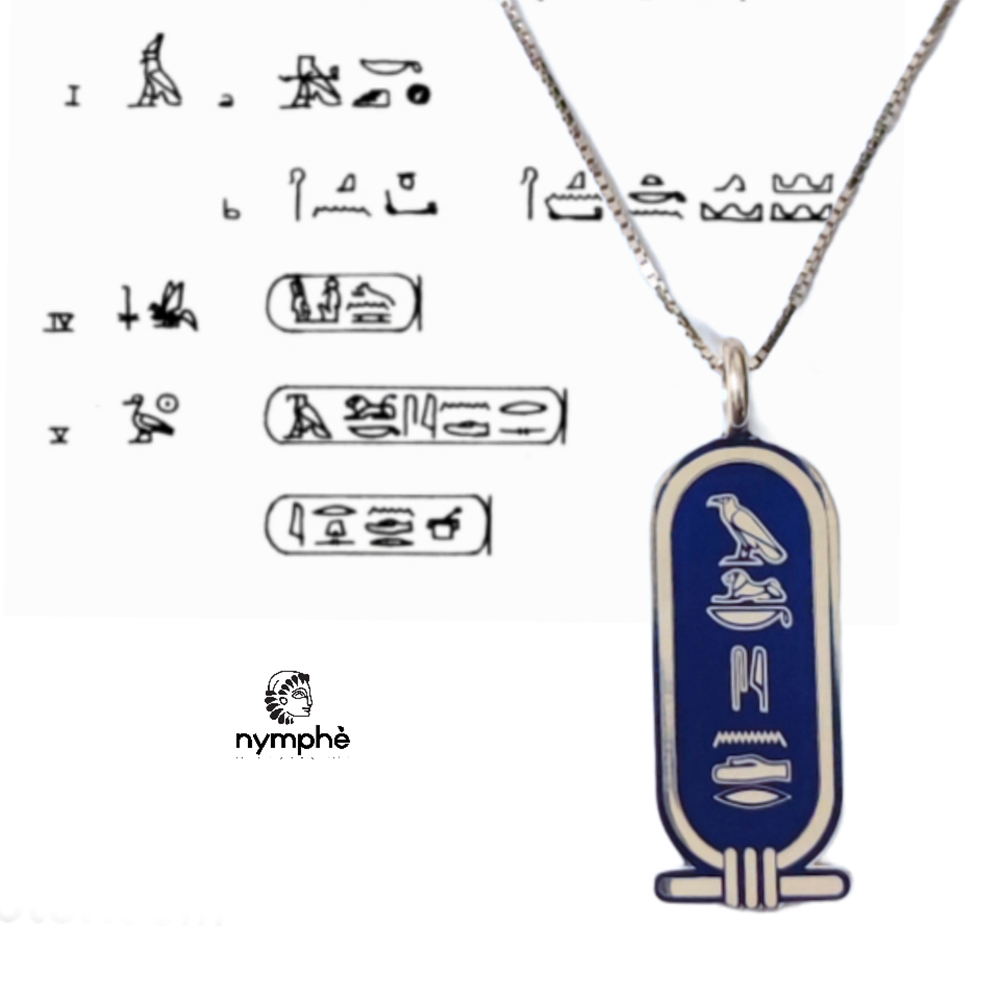
“The cartouche, called in Egyptian šnw (shenu) from the verb šnj (‘to encircle’), is a sacred sign that contained the sovereign’s personal birth name in the form of a magical knot—a loop of two parallel ropes tied together at the ends. Originally circular, it assumed an elliptical shape to accommodate longer names. The complete royal titulary of a Pharaoh was composed of five names: 1) the ancient Horus name, 2) the Two Ladies name, 3) the Golden Horus name, 4) the throne name ‘King of Upper and Lower Egypt’, and 5) the personal birth name as ‘Son of Ra’.”
🇪🇬❤️🏛️
The CARTOUCHE is a sacred sign, known in ancient Egyptian as šnw (shenu) from the verb šnj = “to encircle”, which enclosed the sovereign’s personal birth name. Originally circular, the cartouche assumed an elliptical shape to accommodate the varying length of names. It is a protective, solar-magical hieroglyph representing a magical knot. In fact, it depicts a loop of rope made of two parallel strands firmly bound together at the bottom by a knot.
However, the complete royal titulary of an Ancient Egyptian ruler was composed of five distinct names: the ancient Horus Name, written inside a fortified enclosure (the srḫ or serekh) surmounted by the falcon god, identifying the king as the earthly incarnation of Horus; the Two Ladies Name (Nb-Ty), associating the sovereign with the patron goddesses of Upper and Lower Egypt; the Golden Horus Name (Bjk-Nbw), equating the king’s essence to the divine as a living cult image; and finally, the throne name Nsw-bjty (“King of Upper and Lower Egypt”) alongside the personal birth name or Son of Ra (sЗ-Rʿ), enclosed within the cartouche, celebrating his divine lineage.
In 332 BC, the Macedonian conqueror Alexander the Great presented himself to the Egyptian people as a legitimate heir to the pharaonic dynasties. Following the Battle of Issus in 333 BC—where he defeated the Achaemenid King Darius III, ending Persian rule—Alexander marched into Egypt as a “liberator” and executed a series of crucial strategic moves: he founded the city of Alexandria, journeyed to the remote Siwa Oasis near the Libyan border (home to the renowned oracle temple of Ammon-Ra), and was there formally hailed as the “son of the god Ammon”—a truly revolutionary act for a Greek ruler.
To consolidate and legitimize his rule over Egypt, Alexander had himself recognized as the son of an Egyptian deity and adopted a full pharaonic titulary (using phonetic spelling to write his own name, Зlksjndrs = Ἀλέξανδρος). Outside Alexandria, he was consistently depicted as a traditional Egyptian Pharaoh, indistinguishable from his predecessors except by the cartouche bearing his name. Although Alexander’s stay on Egyptian soil was brief, historical accounts by Quintus Curtius Rufus, Diodorus Siculus, and Justin record that on his deathbed, Alexander asked to be buried neither in his native Macedonia nor in Persia according to Achaemenid tradition—near the Tomb of Cyrus, which he had restored—but rather to rest near the temple of the Siwa Oasis, in seamless continuity with a millennial pharaonic tradition.






Reviews
There are no reviews yet.