The Winged Victory of Samothrace

🪽“Headless, armless, separated from her hand—a recent recovery—worn smooth by all the gusts of the Sporades, the Winged Victory of Samothrace has become less a woman and more a wind of sea and air.”


Marguerite Yourcenar (That Mighty Sculptor, Time)

70,00 

Scegli la lega metallica che preferisci

Order total:

Condividi

Scheda Archeologica
Here is the English translation, refined to match the poetic tone and art-historical vocabulary of your text:

The writer hits the mark: this sculpture is not merely a human creation, but a miracle of time and of the way the past has brought beauty into our present.

Indeed, despite her incompleteness, the goddess of victory remains unforgettable; in the heart of every art lover—and especially of an archaeologist like me, long before I even became one—she takes her place and stays forever.

And with this necklace, the Nike has never been so close to the heart.

The chiton clings to the skin of her chest and legs while blowing back behind her—we can almost feel the wind. In the same way, we admire her material, sensual, and weightless beauty.

The goddess is swooping down onto the prow of a ship, seeking stability by leaning on her right leg while the rest of her body pulls back.

Crafted from Parian marble around 190 BCE, the sculpture is attributed to Pythokritos. It was set atop the prow of a massive marble ship in a sanctuary dedicated to the Great Gods (Cabeiri) perched on a hill on the Greek island of Samothrace. It was built as an offering of gratitude to the gods following a naval victory, likely won by the fleet of Rhodes.

Today, we can admire her in Paris at the Louvre Museum.

La dea dormiente, infatti, si confronta unicamente con un’altra venere sdraiata dallo stesso ipogeo, più grezza e dalle forme più approssimate.
La posizione racchiusa in un’ideale forma ovoidale, è la medesima in cui venivano deposti i defunti all’ interno dell’ipogeo. Tale dato, assieme alla sua probabile collocazione accanto a questi, ha indotto gli studiosi a ipotizzarne una sua funzione propiziatoria di rinascita in un mondo ultraterreno: infatti, oltre all’ormai noto simbolo di fertilità rappresentato da queste icone femminili preistoriche. La sleeping lady maltese si configura come emblema della funzione sacra e rigenerante del sonno della dea, del riposo eterno da cui, ciclicamente, rinasce nuova vita (Percovich, L., 2013)”.

Casi, C. et al., 2016. La donna nell’Antichità. Archeologia e storia della condizione
femminile dalla Preistoria al Medioevo. Laurum Editrice.
Kultermann, U., 1990. Woman Asleep and the Artist. Artibus et Historiae , 1990, Vol. 11,
No. 22 (1990), pp. 129-161
Percovich, L., 2013. Oscure madri splendenti: le radici del sacro e delle religioni. Venexia
Editrice.
Polo, A. et al., 2011. Le spirali nei templi neolitici di Malta e Gozo.
Materiali e Tecnica

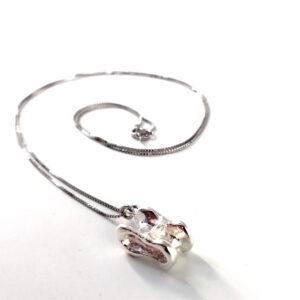
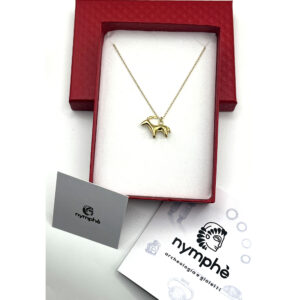
The piece of jewelry is made of Italian 925 sterling silver, rhodium-plated/gold-plated.

The prototypes were created based on digital designs developed through the comparison of various photos of the original artifacts. The designs were subsequently refined for 3D printing. The resin-printed models were used to craft rubber molds to create the wax patterns. These wax models were then cast in metal using the ancient lost-wax casting technique. The cast pieces were hand-finished, followed by the soldering of additional elements and polishing. The process was completed with rhodium plating or gold plating.

Commenti archelogici (0)

Reviews

There are no reviews yet.

Be the first to review “The Winged Victory of Samothrace”

Your email address will not be published. Required fields are marked *

Shopping cart

Sign in

No account yet?

Start typing to see products you are looking for.
Shop
0 Wishlist
0 items Cart
My account